Diagnostic Session Timeouts in Manual UDS Testing
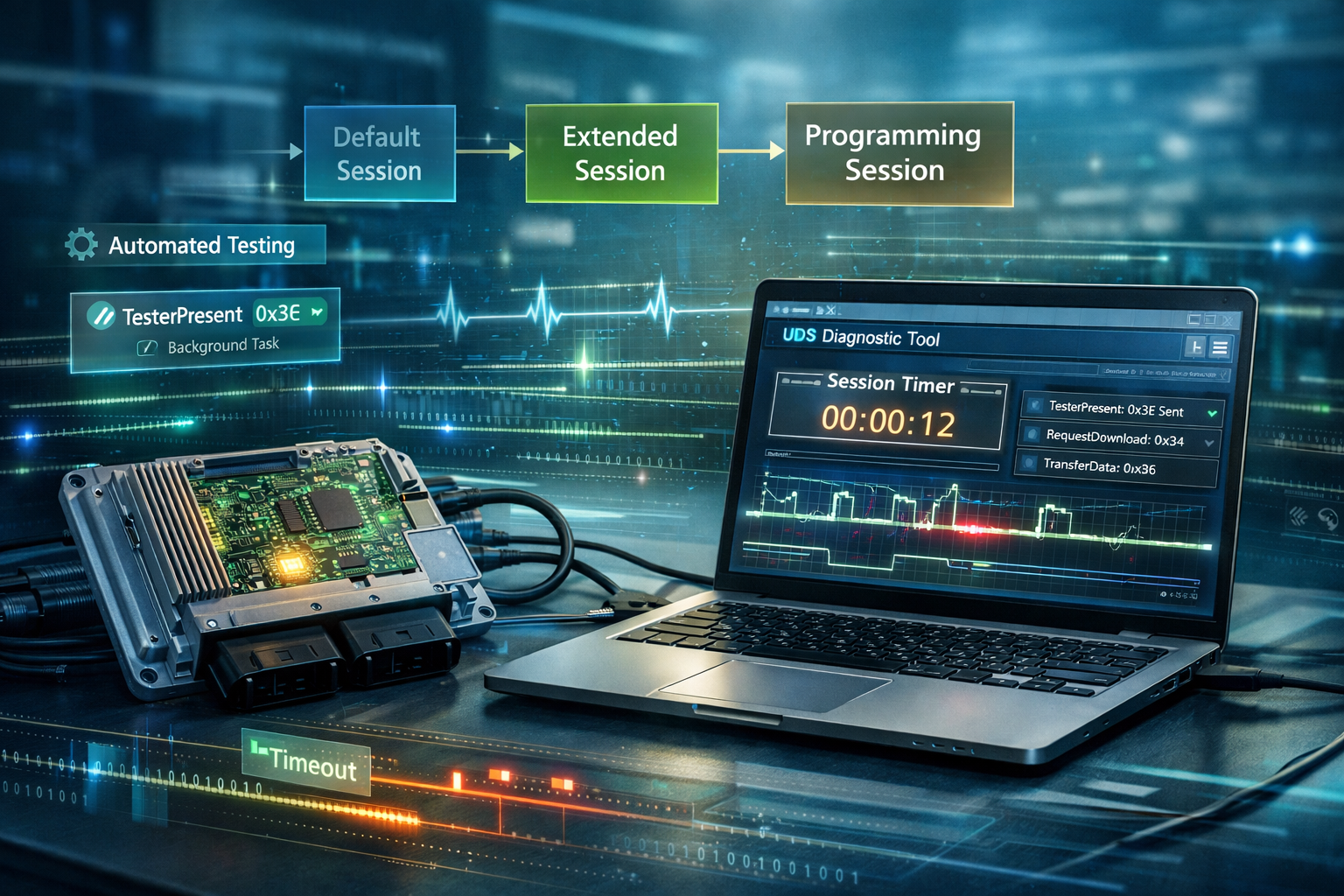
Unified Diagnostic Services (UDS), defined by ISO 14229, is designed to provide a deterministic and secure communication interface between an external diagnostic tester and an Electronic Control Unit (ECU). While the protocol is robust and well-specified, its session-based execution model exposes a fundamental limitation when diagnostic workflows are executed manually. One of the most common manifestations of this limitation is diagnostic session timeout.
Session timeouts are not exceptional events in manual UDS testing; they are a structural consequence of applying human-paced workflows to a protocol that enforces strict timing guarantees.
Diagnostic Sessions and the S3 Server Timer
UDS uses diagnostic sessions-such as Default Session, Extended Diagnostic Session, and Programming Session-to control access to services that can modify ECU state, memory, or security levels. Once a tester transitions the ECU into a non-default session using DiagnosticSessionControl (0x10), the ECU activates the S3 server timer.
The S3 timer defines the maximum allowable inactivity period between valid diagnostic requests. If this timer expires, the ECU assumes the diagnostic connection has been lost and automatically reverts to the Default Session. This behavior is intentional and safeguards the ECU against unintended prolonged access.
From the ECU’s perspective, a timeout is indistinguishable from a tester disconnect.
Why Manual Testing Triggers Session Timeouts
In manual diagnostic workflows, session stability is implicitly dependent on continuous tester interaction. This creates several structural challenges:
- Human Execution Latency: Manual actions such as selecting the next service, preparing parameters, loading firmware files, or referencing documentation routinely exceed typical S3 timeout values.
- TesterPresent Coordination Overhead: Maintaining an active session requires periodic transmission of the TesterPresent service (0x3E). In manual testing, the tester must explicitly remember to send this service while also executing primary diagnostic actions-an inherently serial and error-prone process.
- Interrupted Long-Running Operations: Services such as RequestDownload (0x34), TransferData (0x36), and RoutineControl (0x31) often involve multiple steps and extended execution times. Any pause between these steps can cause the session to expire mid-operation.
- Recovery Overhead: Once a session times out, subsequent requests are rejected. Recovery typically requires restarting the session sequence or resetting the ECU, increasing test cycle time and introducing inconsistency.
These failures are not caused by incorrect service usage but by the mismatch between protocol timing expectations and human-driven execution.
Why This Is a Structural Limitation
Manual testing tools generally expose UDS services as discrete actions. Session maintenance is treated as an implicit responsibility of the tester rather than an explicit system function. As a result:
- Session lifecycle is not modeled explicitly
- Background signaling is not guaranteed
- Timing behavior varies between executions
- Repeatability is difficult to achieve
This makes session timeouts not just possible, but inevitable in complex or long-running diagnostic workflows.
Addressing Session Timeouts with Automated UDS Execution
Automated diagnostic frameworks approach session management differently by separating session maintenance from test intent. In TestBot, this separation is implemented through its agent-based architecture.
TestBot UDS Flow for Session Stability
TestBot’s UDS Agent models the diagnostic session as a first-class entity rather than an implicit side effect of service execution.
A typical TestBot flow for UDS testing includes:
- Session Initialization: The test sequence explicitly transitions the ECU into the required diagnostic session (Extended or Programming) using DiagnosticSessionControl.
- Background Session Maintenance: Once the session is active, the UDS Agent automatically transmits TesterPresent (0x3E) messages at protocol-compliant intervals as a background task. This ensures the S3 server timer is continuously reset.
- Primary Diagnostic Execution: While session stability is maintained in the background, the main test flow executes diagnostic services such as security access sequences, routine controls, data identifier reads and writes, and firmware download and transfer operations.
- Deterministic Completion: Long-running operations complete without interruption, regardless of execution time, intermediate validations, or conditional logic in the test flow.
By decoupling session maintenance from service execution, TestBot removes session timing as a variable that can influence test outcomes.
Practical Example: Firmware Download Workflow
In a manual testing setup, a firmware download operation is highly susceptible to session timeout. Any delay between RequestDownload and subsequent TransferData requests-whether due to file preparation or operator interaction-can cause the ECU to revert to the Default Session, resulting in rejected data transfers.
In a TestBot-driven flow, the firmware download sequence is executed as a continuous, automated process. The UDS Agent maintains the Programming Session throughout the operation, allowing segmented data transfers and intermediate validations to proceed without risking session loss.
Conclusion
Diagnostic session timeouts in UDS testing are not isolated errors or operator mistakes. They are a structural limitation of manual diagnostic execution applied to a protocol designed for deterministic, machine-driven communication.
By explicitly modeling session lifecycle and automating session maintenance, TestBot enables stable, repeatable, and scalable UDS testing. This approach allows engineers to focus on validating ECU behavior and protocol compliance rather than compensating for timing constraints inherent in manual workflows.
Related Product Page
Automate UDS Diagnostic Sessions With TestBot
The UDS Client Agent handles all 22 ISO 14229 services - session management, security access, DID read/write, fault memory, and flash programming - eliminating the timeout and repeatability issues described in this article.