CASE STUDY SNAPSHOT
Customer : A leading player in the Industrial Automation industryProject vertical : Industrial Automation
Challenge : Needed comprehensive, synchronized, and scalable end-to-end validation of a Serial IoT Gateway (hardware, firmware, Modbus, Wi-Fi/Bluetooth, cloud).
Solution : Utilized TestBot, a unified automated testing framework with a multi-agent architecture and custom TestJig integration, to cover device-level and cloud-level functionalities.
Tools and Technologies :
- Framework: TestBot (Unified automated testing framework)
- Agents: Webserver Agent, Mobile App Agent, Modbus Agent, TestJig Agent
- Integration: Custom TestJig for physical hardware simulation (buttons, LEDs)
- Protocol: Modbus
Customer Overview
A leading player in the Industrial Automation industry developed a Serial IoT Gateway designed to communicate with fire alarm panels and transmit device data to the cloud. The gateway was a key component in their connected safety ecosystem, ensuring real-time monitoring, data logging, and alert generation.
Challenge
The customer needed to validate the gateway’s complete functionality, from device boot-up to cloud data visualization. They faced a multi-layered testing challenge:
- The gateway involved complex interactions across hardware, firmware, Modbus protocol, wireless connectivity, and cloud applications.
- Manual testing was highly repetitive - verifying configuration pages, Modbus registers, LED indicators, Wi-Fi/Bluetooth states, and firmware upgrades consumed days.
- Each firmware iteration required complete regression testing, which was hard to repeat consistently.
- Validation of cloud dashboards and mobile apps alongside the physical device further increased complexity.
In short, testing needed to be comprehensive, synchronized, and scalable - something human testers alone couldn’t deliver reliably or efficiently.
TestBot Solution
The team leveraged TestBot, our unified automated testing framework, to perform end-to-end validation of the gateway covering both device-level and cloud-level functionalities.
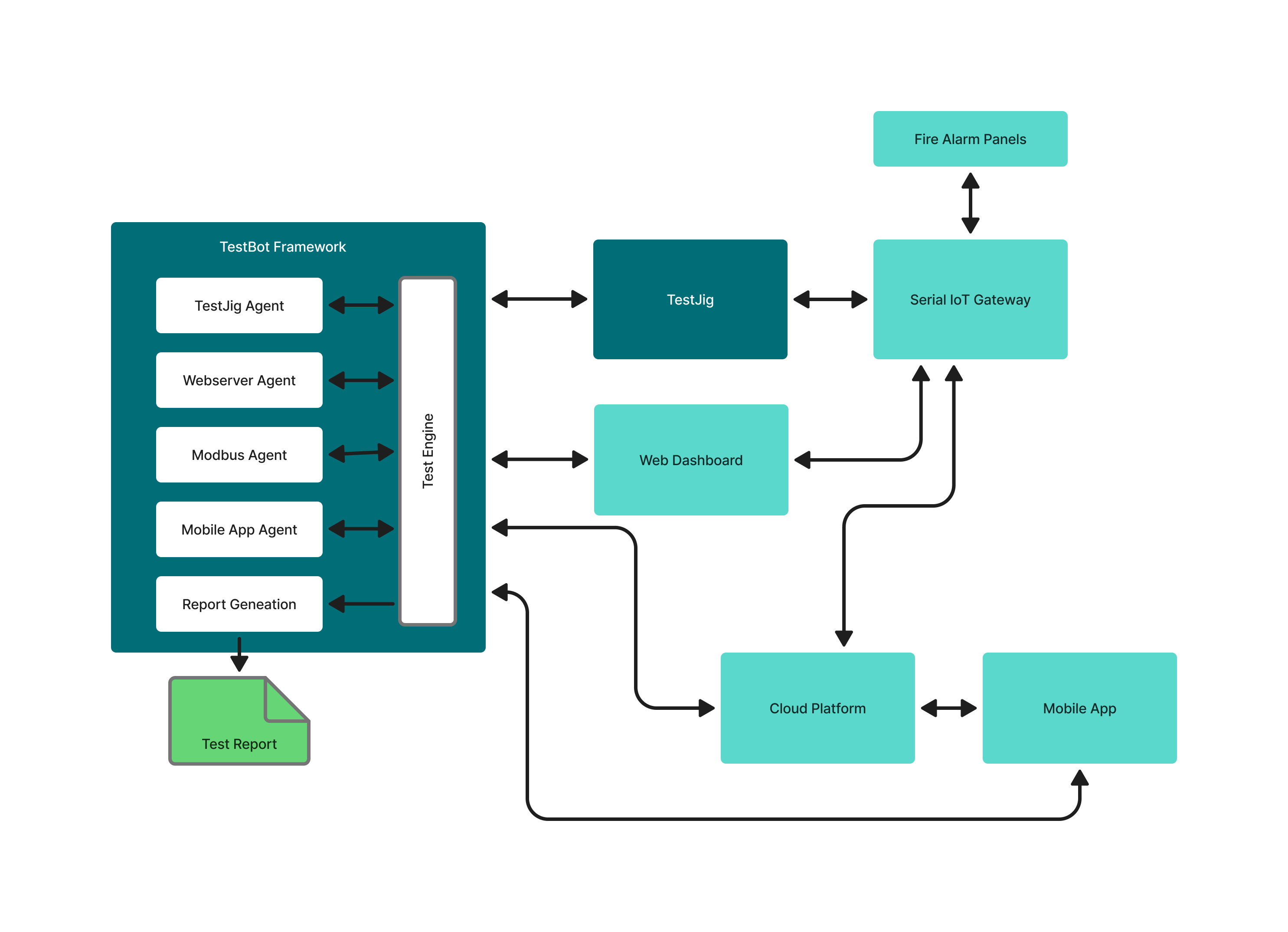
TestBot stood out for three key reasons:
- Unified Multi-Agent Architecture: It allowed simultaneous testing of the embedded gateway, Modbus communication, web interface, and mobile app in one coordinated test flow.
- Hardware-Software Synchronization: Through a customized TestJig connected to TestBot’s TestJig Agent, physical events like button presses and LED status checks were automated with precise timing.
- Reusability & Regression Efficiency: Once the automated suite was created, the same tests could be re-run across firmware versions or product variants - cutting down weeks of manual effort to hours.
Key Testing Areas Covered
- Web Configuration Portal: Automated validation of the gateway’s configuration webpage, including login, settings update, and configuration persistence.
- Device Indicators: Verification of LED indications during boot, firmware update, and fault states using a customized TestJig connected to the TestBot TestJig Agent.
- Webserver Launch: Testing the device’s embedded webserver launch sequence and response accuracy.
- Bluetooth & Wi-Fi Connectivity: Automated pairing, connection stability, and data transmission validation.
- Modbus Communication: End-to-end testing of register configuration, read/write operations, and response verification using Modbus Agent.
- Firmware Upgrade: Validation of OTA (Over-the-Air) and local firmware update mechanisms.
- Data-to-Cloud Verification: Ensured that all device data packets were correctly formatted, transmitted, and stored in the cloud platform.
- Cloud Application Tests: Automated validation of cloud web and mobile applications, ensuring accurate data display, alarm generation, and acknowledgment workflows using Webserver Agent and Mobile App Agent.
Hardware Integration
A custom TestJig was designed and integrated with TestBot to simulate physical user interactions-pressing buttons, reading LED statuses, and monitoring device behavior in real time. This allowed the framework to perform both functional and behavioral testing automatically without human intervention.
Tools & Agents Used
- Webserver Agent – for testing configuration and cloud web interface
- Mobile App Agent – for mobile app validation
- Modbus Agent – for register and data communication testin
- TestJig Agent – for physical interface testing (LEDs, buttons)
Results
- Achieved 100% test coverage across hardware, firmware, and cloud interfaces
- Reduced overall test execution time by 80%
- Detected critical firmware issues early in the cycle
- Enabled repeatable, version-independent regression testing
- Provided unified test reports for device, Modbus, and cloud validations
Impact
With TestBot’s modular agents and customized hardware integration, the customer achieved comprehensive, automated validation of their gateway in record time. The automation framework now forms the backbone of their continuous validation process for future firmware and feature releases.
Conclusion
By leveraging the unified TestBot framework, the customer successfully transitioned from time-consuming manual testing to a highly efficient, automated end-to-end validation process, ensuring the quality and reliability of their critical IoT Gateway for Building Automation.