CASE STUDY SNAPSHOT
Customer : A leading provider of IoT-enabled Industrial and Smart Building solutionsProject vertical : Industrial IoT / Smart Infrastructure
Challenge : Validating that an IoT gateway correctly switches between Wi-Fi and Ethernet connections, and that the cloud dashboard continues reflecting live updated values throughout every network transition - in a repeatable and automated way.
Solution : Implemented TestBot with Wi-Fi Agent, Ethernet Agent, a Raspberry Pi-based Wi-Fi and Ethernet TestJig, and Web Server Agent to physically toggle network interfaces, monitor the cloud dashboard for live value updates, and validate gateway LED status - all in a single automated test flow.
Tools and Technologies :
- Framework: TestBot (Unified automated testing framework)
- Agents: Wi-Fi Agent, Ethernet Agent, Web Server Agent
- Hardware: TestJig – LED Monitoring, Wi-Fi and Ethernet
- Protocol: Wi-Fi (802.11 b/g/n), Ethernet (10/100 Mbps), HTTP
Customer Overview
The customer develops IoT gateways deployed across smart buildings and industrial edge environments. These gateways collect data from connected field devices and forward it to a cloud platform for real-time monitoring. The gateway hosts a cloud dashboard that continuously displays the latest sensor values and timestamps, giving operators live visibility into device status.
To ensure uninterrupted operation, the gateway supports two network interfaces - Wi-Fi and Ethernet - and must automatically switch between them when one connection is lost, without any disruption to the cloud dashboard.
Challenge
Validating the gateway’s network redundancy behaviour posed several real-world testing challenges:
- Physically turning off and on the Wi-Fi and Ethernet interfaces had to be done in a controlled, repeatable way - manual cable pulling or toggling access points introduced inconsistent timing.
- While the network was being switched, the cloud dashboard had to be simultaneously monitored to confirm that the latest data values and timestamps continued updating without stalling.
- The gateway’s LED indicators needed to be checked to confirm it had recognised the network change and switched to the correct interface.
- Coordinating physical interface control, live dashboard monitoring, and LED observation all at once was not feasible through manual testing.
In short, the test required tight synchronization between hardware control, application-layer observation, and visual status confirmation - a combination that manual testing could not deliver reliably.
TestBot Solution
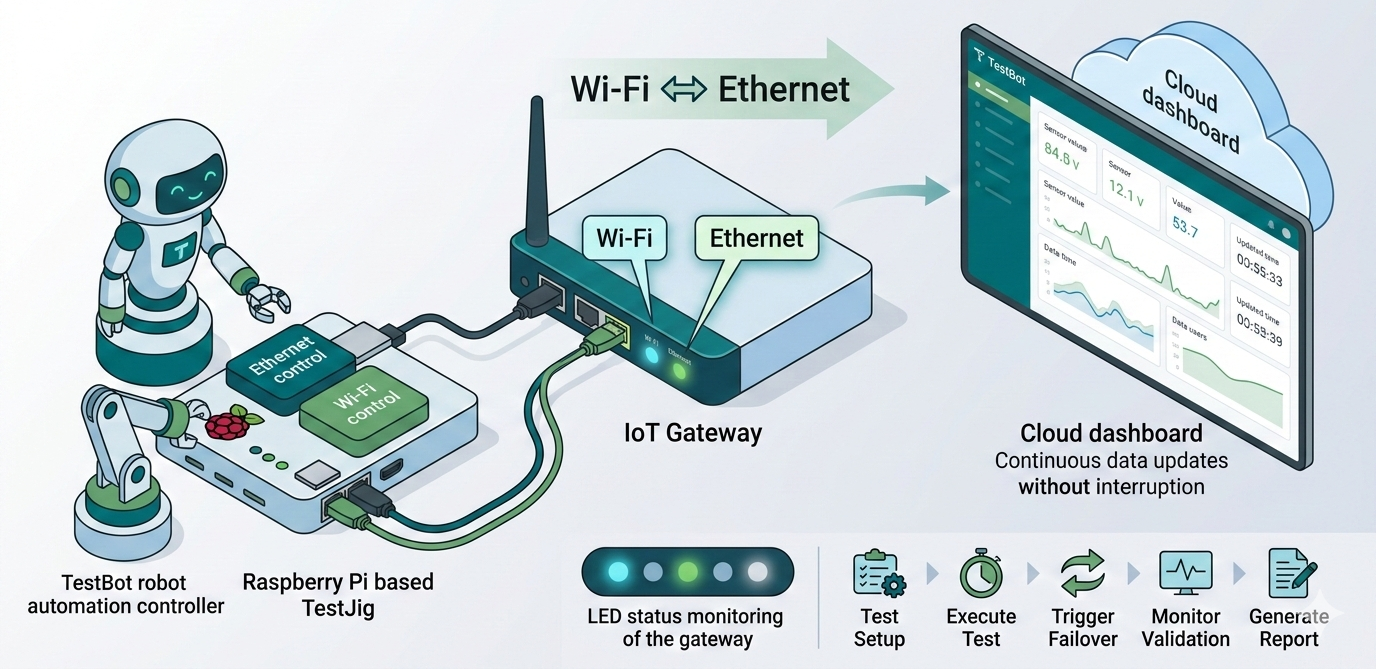
The team used TestBot to automate the entire network redundancy validation by combining a Raspberry Pi-based TestJig with its agent-based architecture, bringing physical interface control, cloud dashboard monitoring, and LED validation into a single coordinated test flow.
TestBot delivered three key advantages:
- Physical Interface Control: The Wi-Fi and Ethernet TestJig, built on Raspberry Pi and controlled by TestBot commands, turned the Wi-Fi and Ethernet interfaces on and off precisely as required by each test scenario.
- Cloud Dashboard Validation: The Web Server Agent opened the cloud dashboard, continuously read the latest updated value and its timestamp, and asserted that the data was actively refreshing - confirming that the gateway’s network connection was live and data was flowing.
- LED Status Verification: TestBot checked the gateway’s LED indicators after each interface switch to confirm the device had correctly recognised the active network and transitioned to the expected state.
Key Testing Areas Covered
- Wi-Fi Interface Control: Wi-Fi Test Jig was configured to act as a Wi-Fi Access point, giving TestBot full control over SSID Broadcast, Connectivity and interface toggling. The Wi-Fi Agent leveraged this to bring the access point on or off precisely on command simulating the Wi-Fi Loss and restoration scenario. Security Mechanism validation was also performed including WPA2 and WPA3 authentication modes, along with radio band coverage across 2.4GHz and 5GHz base on geography.
- Ethernet Interface Control: Ethernet Agent and the Raspberry Pi TestJig turned the Ethernet interface off and on to simulate cable disconnection and reconnection scenarios. The TestJig also ran a DHCP server, enabling validation of address assignment behaviour upon reconnection and ensure the gateway correctly acquired the network configurationa after Ethernet Restoration.
- Cloud Dashboard Monitoring: Web Server Agent continuously polled the cloud dashboard, reading the latest sensor value and its associated timestamp after every interface toggle.
- Live Value Validation: TestBot asserted that the value displayed on the dashboard was changing and the timestamp was being updated - confirming active data flow through the currently connected interface.
- Gateway LED Validation:TestBot monitored the gateway’s LED indicators using the LDR based light detection mechanism to confirm the device visually reflected the correct network state after each switch.
- End-to-End Redundancy Flow: Full validation from interface power-off through failover detection, dashboard continuity, LED confirmation, and successful recovery on the restored interface.
Hardware Integration
A custom TestJig was built on a Raspberry Pi and integrated with TestBot which controls WiFi and Ethernet switching and monitors the LED status of the Gateway. The TestJig receives commands directly from TestBot to enable or disable each network interface on the gateway, simulating real network failures in a precise and repeatable way. This eliminates the variability of manual interface toggling and ensures every test run starts from the same controlled state.
The TestJig works alongside the Wi-Fi Agent and Ethernet Agent, which manage the interface states and communicate results back to the TestBot test engine.
Tools & Agents Used
- Wi-Fi Agent – manages and monitors the gateway’s Wi-Fi interface state during testing
- Ethernet Agent acts as a Wifi-Access Point and DHCP server; physically turns Wi-Fi and Ethernet on and off via TestBot commands
- LED Light detecting TestJig (Raspberry Pi) - Using LDR detects the light on, off and blink state of the Wi-Fi and Ethernet Indication LEDs.
- Wi-Fi & Ethernet TestJig (Raspberry Pi) – physically turns Wi-Fi and Ethernet on and off via TestBot commands
- Web Server Agent – opens the cloud dashboard, reads the latest updated value and timestamp, and validates that data is actively refreshing after each network switch
Results
- Successfully validated both Wi-Fi-to-Ethernet and Ethernet-to-Wi-Fi failover paths with cloud dashboard continuity confirmed in each scenario
- Cloud dashboard values and timestamps were verified to keep updating immediately after each interface switch, confirming seamless data flow
- Gateway LED status correctly reflected the active network interface in all tested transitions
- Eliminated manual coordination between hardware toggling, dashboard observation, and LED checking
- Provided automated pass/fail reports with timestamped dashboard readings and LED states as evidence for every test run
- Enabled network redundancy validation to run as a repeatable regression suite across firmware releases
Impact
By combining the TestJig with the Wi-Fi Agent, Ethernet Agent, and Web Server Agent, TestBot validated network redundancy at every layer - physical interface control, application-layer dashboard continuity, and device-level LED confirmation. The customer gained full confidence that when either network interface fails, the gateway switches correctly, the cloud dashboard keeps updating without interruption, and the device status is accurately reflected.
A process that previously required multiple people to coordinate simultaneously became a single-click automated test.
Conclusion
Using TestBot’s Wi-Fi Agent, Ethernet Agent, Web Server Agent and custom TestJig, the IoT gateway’s network redundancy was validated end-to-end - from physical interface switching through to live cloud dashboard value updates and LED status confirmation. TestBot’s agent-based architecture brought hardware control and application-layer validation into a single automated framework, ensuring every firmware release ships with verified, reliable network redundancy.