HIL Testing for De-Risking Complex Projects
Today, embedded systems are the silent architects of innovation, powering everything from advanced automotive features and industrial automation to life-saving medical devices. As these systems grow in complexity, so do the challenges of ensuring their reliability, performance, and safety. Traditional testing methodologies, while valuable, often fall short when confronted with the intricate interplay of hardware and software in real-world scenarios. This is where Hardware-in-the-Loop (HIL) testing emerges not just as a testing method, but as a strategic imperative – your secret weapon for de-risking complex projects.
We've witnessed firsthand the transformative power of HIL testing. It’s more than just a buzzword; it’s a methodology that bridges the gap between simulation and reality, providing a robust, repeatable, and safe environment to rigorously validate your embedded systems.
The Business Imperative: Why HIL is Not a Luxury, But a Necessity
Let's cut to the chase: in the competitive landscape of embedded systems development, time-to-market, cost-efficiency, and product quality are paramount. HIL testing directly impacts all three, offering tangible business benefits:
- Reduced Development Costs: Identifying design flaws early in the development cycle is significantly cheaper than discovering them during physical prototyping or, worse, after deployment. HIL allows you to virtually 'crash test' your system thousands of times without incurring the costs of damaged physical hardware. This is crucial for embedded systems validation.
- Accelerated Time-to-Market: By providing a highly automated and repeatable testing environment, HIL testing drastically reduces the manual effort and time spent on validation. This allows development teams to iterate faster, bring products to market quicker, and gain a critical competitive edge.
- Enhanced Product Quality and Reliability: HIL allows for comprehensive testing of edge cases, fault injection scenarios, and environmental extremes that are difficult, expensive, or dangerous to replicate with physical hardware. This leads to more robust and reliable products, reducing warranty claims and enhancing customer satisfaction.
- Improved Safety and Compliance: For safety-critical applications (e.g., automotive ADAS, avionics, medical devices), HIL testing is indispensable for demonstrating compliance with stringent industry regulations and standards. It provides documented evidence of thorough testing under a wide range of conditions, ensuring the highest levels of safety.
- Risk Mitigation: By simulating the real-world environment, HIL testing proactively identifies and addresses potential risks before they escalate into costly failures or project delays. This systematic approach to hardware-in-the-loop significantly de-risks complex projects.
Unpacking the Power of HIL: How It Works and What It Offers
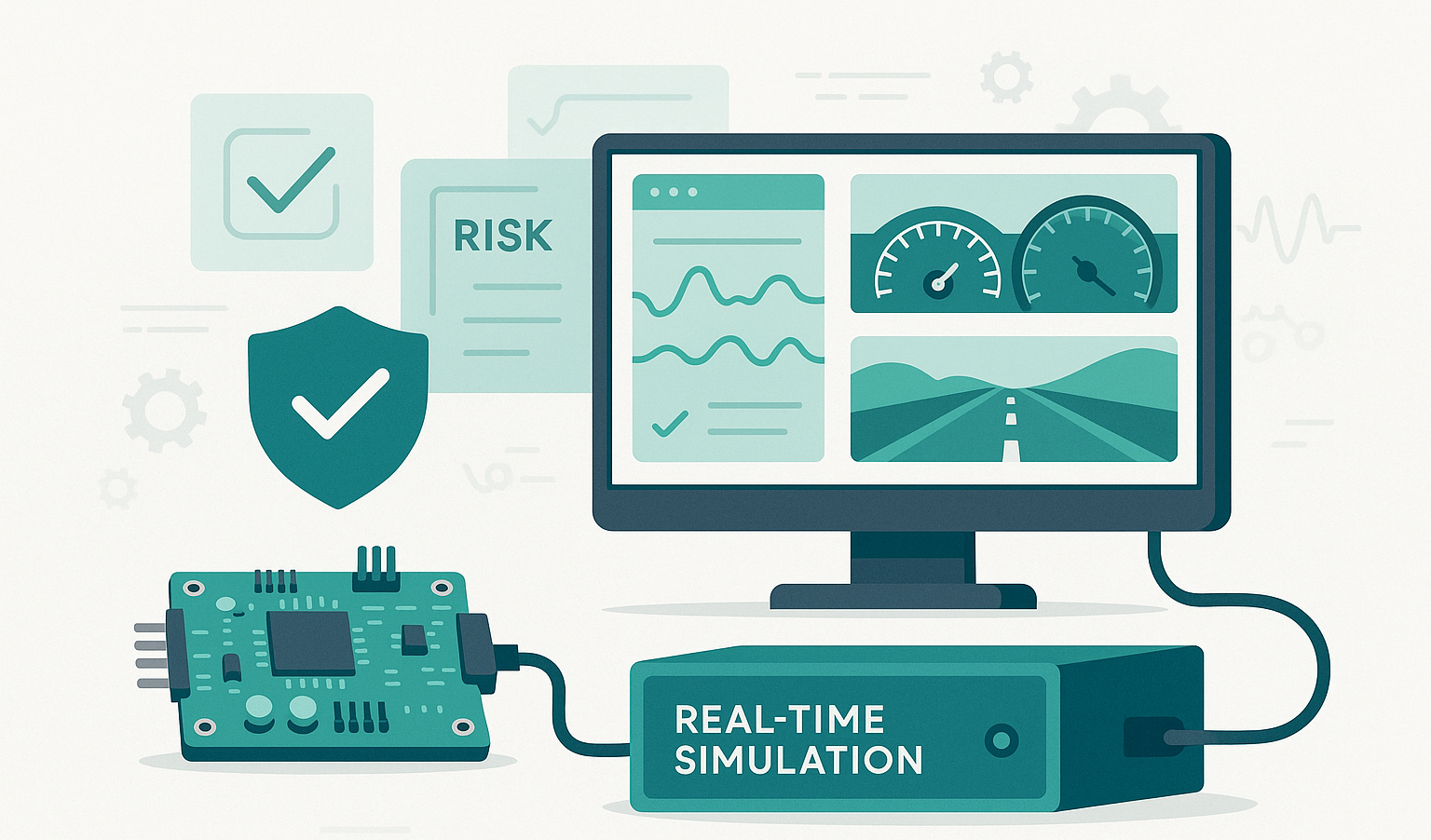
At its core, HIL testing involves connecting your actual embedded controller (the Device Under Test or DUT) to a simulated environment that mimics the behaviour of the real-world system it will interact with. This simulation can include anything from sensors and actuators to environmental conditions and complex dynamics.
Key components of an HIL setup typically include:
- Real-time Simulator: This is the brain of the HIL system, running mathematical models of the physical plant (e.g., engine, vehicle dynamics, robotic arm) in real-time.
- I/O Interfaces: These provide the necessary connections between the simulator and the DUT, converting digital and analog signals to mimic real-world inputs and outputs.
- Fault Injection Capabilities: A critical feature for embedded systems validation, allowing testers to simulate various sensor failures, communication errors, or power fluctuations to observe the DUT's response.
- Test Automation Software: This orchestrates the entire testing process, managing test sequences, data logging, and analysis.
For embedded system developers and testers, HIL offers unparalleled advantages:
- Early Detection of Integration Issues: Catching mismatches between hardware and software early in the development cycle, before costly physical prototypes are built.
- Regression Testing Efficiency: Rapidly re-run comprehensive test suites after software or hardware changes, ensuring that new modifications haven't introduced regressions.
- Non-Destructive Testing: Test destructive scenarios (e.g., overvoltage, extreme temperatures) without damaging actual hardware.
- Reproducibility: Precisely reproduce specific fault conditions or environmental scenarios for in-depth debugging and analysis, a key benefit for hardware-in-the-loop systems.
- Parallel Development: Hardware and software teams can work in parallel, with software development and testing proceeding even before the final physical hardware is available.
Beyond the Basics: Advanced HIL for the Modern Embedded Landscape
As embedded systems become more sophisticated, so too must our testing approaches. Advanced HIL strategies address emerging challenges:
- Model-Based Design Integration: Seamlessly integrating HIL with Model-Based Design (MBD) workflows, where system models are used throughout the development lifecycle, from requirements to validation. This ensures consistency and reduces errors.
- Cybersecurity Testing: HIL environments can be used to simulate cyber-attacks and evaluate the resilience of embedded systems to various threats, a growing concern for connected devices.
- Fault-Tolerant System Validation: Rigorously testing systems designed to continue operating even after component failures, crucial for high-availability applications.
- Scalability for Distributed Systems: Adapting HIL for testing interconnected embedded systems, such as those found in smart factories or autonomous vehicle fleets.
Your Path to De-Risked Projects: Introducing TestBot Automated Testing Framework
We understand that implementing a robust HIL strategy can seem daunting. That's why we’ve developed TestBot Automated Testing Framework – a comprehensive solution designed to empower embedded system developers and testers to harness the full potential of HIL.
TestBot is not just a tool; it's a complete ecosystem for automated testing and embedded systems validation. Here’s how it becomes your essential partner in de-risking complex projects:
- Intuitive Interface: TestBot provides a user-friendly interface that simplifies the creation and execution of complex HIL test sequences, reducing the learning curve for your team.
- Flexible Integration: Designed for seamless integration with a wide range of hardware platforms, real-time simulators, and development tools, TestBot adapts to your existing ecosystem.
- Powerful Scripting and Automation: Automate repetitive tests, manage test cases, and generate comprehensive reports with ease. This frees up your engineers to focus on more complex problem-solving.
- Comprehensive Test Coverage: TestBot enables you to achieve high test coverage, including stress testing, regression testing, and fault injection, ensuring every corner of your system is thoroughly validated.
- Scalability for Any Project: Whether you're working on a small IoT device or a complex automotive ECU, TestBot scales to meet the demands of your project, making HIL testing accessible for all.
- Data Analysis and Reporting: Robust data logging and analysis capabilities provide actionable insights into your system's performance, helping you identify and rectify issues quickly.
By leveraging TestBot, you can transform your testing process from a bottleneck into a powerful accelerator. Imagine the confidence of knowing your embedded system has been rigorously tested against real-world scenarios, all within a controlled, repeatable, and efficient environment.
Conclusion: Embrace HIL for a Future of Certainty
In the realm of embedded systems, uncertainty is the enemy of innovation and profitability. Hardware-in-the-Loop (HIL) testing is your strategic ally in combating this uncertainty. It’s the investment that pays dividends in reduced costs, faster time-to-market, superior product quality, and unparalleled safety.
We are committed to helping you navigate the complexities of embedded systems development. With TestBot Automated Testing Framework, we provide the tools and expertise to make HIL testing not just a concept, but a tangible reality for your projects.
Don't let the complexity of your next embedded system project overwhelm you. Embrace HIL testing with TestBot and unlock your secret weapon for success. Contact us today to learn how TestBot can revolutionize your embedded systems validation and help you truly de-risk complex projects.