End-of-Line (EOL) Testing of MCU-Based PCB Assemblies
A Comprehensive Guide to Embedded Systems Testing and Manufacturing Quality with TestBot
Introduction
In modern electronics manufacturing, ensuring product reliability is not optional - it is fundamental. Regardless of product type or production scale, one process remains central to quality assurance: End-of-Line (EOL) testing. Positioned as the final checkpoint before shipment, EOL testing validates whether a product truly performs as designed.
For MCU-based PCB assemblies, this process becomes even more critical. These assemblies represent complete embedded systems where hardware and firmware must function seamlessly together. This is precisely where TestBot steps in - Embien's automated testing framework built to handle the full complexity of embedded EOL testing. TestBot ensures that every unit leaving the production line meets defined functional, electrical, and performance expectations in a consistent, repeatable, and automated manner.
What Is End-of-Line (EOL) Testing?
End-of-Line (EOL) testing is the final inspection and validation stage conducted at the end of the production line, just before a product is packaged and delivered to customers. It serves as definitive proof that the product operates according to its design specifications.
EOL testing goes far beyond simple power-on checks. It includes functional validation, firmware verification, communication interface testing, and electrical parameter analysis - all executed in an automated environment capable of supporting high-volume manufacturing. TestBot's agent-based architecture is purpose-built for exactly this kind of multi-layered, automated test execution across embedded products.
Why EOL Testing Is Essential
Skipping or weakening EOL testing can lead to significant downstream consequences - field failures, warranty claims, and reputational damage. Detecting defects at the production stage is far more cost-effective than addressing issues after deployment.
EOL testing plays a crucial role in:
- Ensuring every unit meets functional and electrical specifications
- Detecting assembly defects such as missing components or soldering issues
- Verifying firmware integrity and correctness
- Meeting regulatory compliance requirements across industries
- Supporting first-pass yield analysis and continuous process improvement
TestBot supports all of these objectives by providing a unified, configurable test automation platform that scales from individual DUT validation to full production line deployment.
Key EOL Test Stages for Electronic Assemblies
EOL testing is a structured sequence of validation stages designed to progressively verify product integrity. TestBot orchestrates each of these stages through its modular agent framework.
Soldering and Assembly Verification (AOI)
Automated Optical Inspection systems detect visible manufacturing defects - solder bridges, misaligned components, missing parts - before electrical testing begins. TestBot integrates with AOI outputs to feed results into a unified test report.
In-Circuit Testing (ICT)
ICT verifies component-level integrity including resistance, capacitance, continuity, and short/open circuits. TestBot's I/O agents interface with ICT fixtures to capture and log results within the same test flow.
Firmware Programming and Verification
The microcontroller is programmed via JTAG, SWD, UART, or SPI. TestBot automates firmware flashing and checksum verification, ensuring every unit receives the correct, verified firmware - eliminating manual programming errors entirely.
Power-On and Startup Testing
The device is powered in a controlled environment while TestBot monitors voltage levels, current consumption, and boot behavior in real time, flagging anomalies automatically.
Functional Testing
This is the core of EOL testing - and the heart of what TestBot does. TestBot operates the system across all intended modes, validating I/O behavior, communication protocols, control logic, and user outputs. Pass/fail conditions are evaluated automatically, with detailed logging for every test cycle.
Communication Interface Testing
UART, SPI, I2C, CAN, LIN, Ethernet, USB, RS-485, Modbus - TestBot's protocol agents cover all major communication interfaces, enabling complete and reliable protocol validation in a single automated run.
Performance and Calibration
Critical parameters such as ADC accuracy, PWM characteristics, and sensor readings are measured by TestBot. Calibration data can be written back to non-volatile memory as part of the test sequence.
Environmental Stress Screening (Optional)
For high-reliability applications, TestBot can be extended to coordinate thermal cycling or burn-in sequences, ensuring latent defects are surfaced before shipment.
EOL Testing Architecture for MCU-Based PCB Assemblies
For MCU-based systems, EOL testing demands a more advanced approach because the DUT is a fully functional embedded system. TestBot's architecture is designed for exactly this.
Test Rig Architecture with TestBot
A TestBot-powered EOL setup includes:
- A TestBot controller managing the full test execution sequence
- Hardware agents with pogo pins for reliable electrical contact
- TestBot's central UI for test configuration, monitoring, and reporting
- Clear pass/fail indicators for immediate operator feedback
This setup delivers the repeatability, accuracy, and scalability that high-volume production demands.
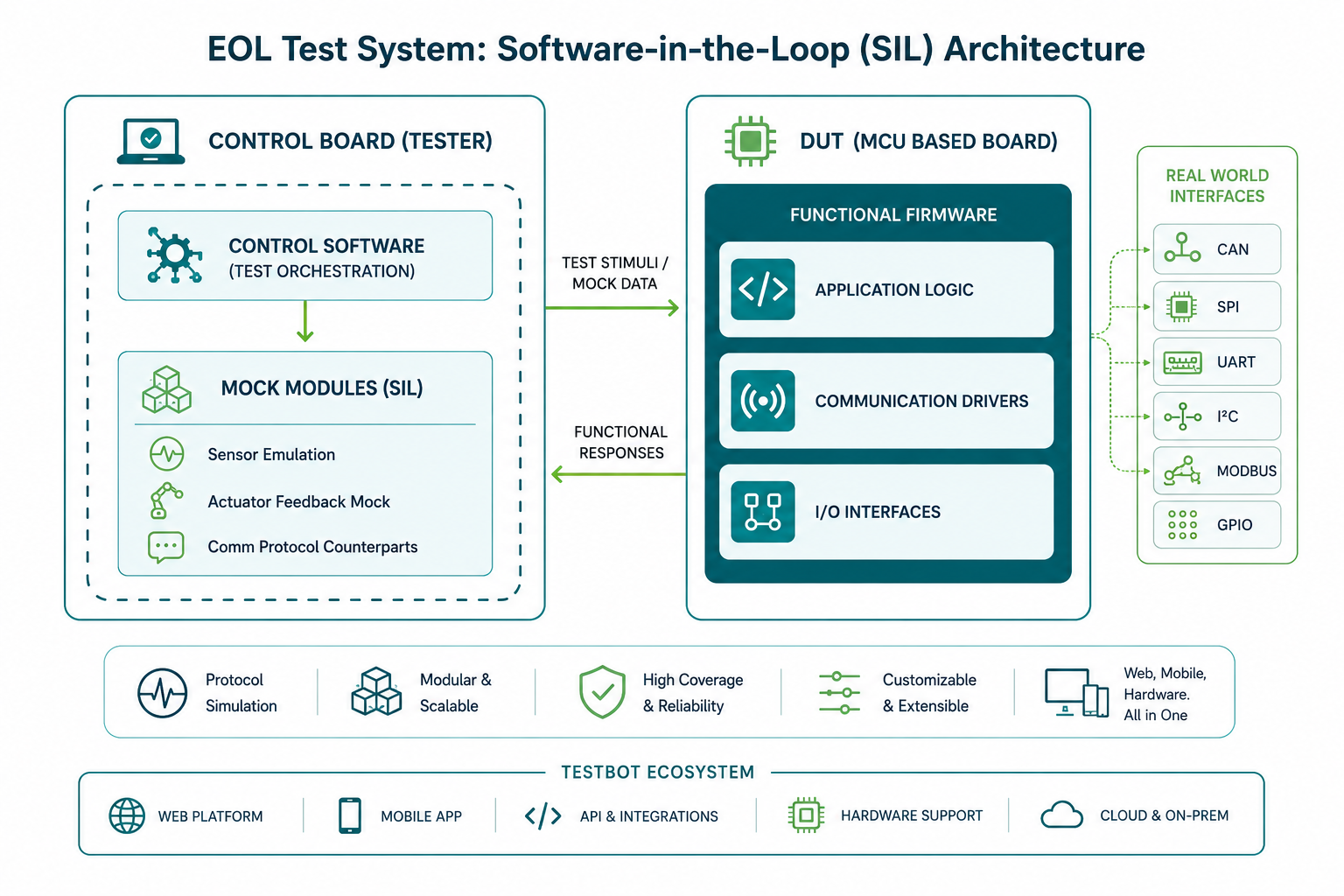
Software-in-Loop (SIL) Testing with TestBot
A defining capability of TestBot's EOL approach is Software-in-Loop (SIL) testing. TestBot simulates the complete external environment of the DUT - sensors, actuators, communication peers - while the DUT runs its actual production firmware.
This means the system behaves exactly as it would in the field, enabling comprehensive validation of both hardware and firmware in a single automated process. No manual stimulus. No guesswork. TestBot handles the simulation, execution, and evaluation end-to-end.
Two-Stage EOL Test Flow in TestBot
TestBot implements EOL testing as a structured two-stage flow:
Stage 1: Hardware Self-Test (Test Firmware)
TestBot loads a diagnostic firmware to independently verify:
- MCU core functionality
- Memory integrity
- Peripheral operation
- Clock and power systems
Each hardware block is tested in isolation, with results logged automatically for pass/fail evaluation.
Stage 2: Functional Testing (Production Firmware)
Once hardware validation passes, TestBot programs the production firmware and transitions immediately to full functional testing under SIL conditions.
This stage includes:
- Simulating real-world inputs via TestBot's agent layer
- Executing all functional sequences defined in the test plan
- Validating outputs against specifications
- Logging deviations with structured fault codes
Only units passing both stages are cleared for shipment.
Test Reporting and Traceability
TestBot generates detailed, structured reports for every unit tested, including:
- Unique device identification
- Test results per stage
- Measured values vs. defined limits
- Firmware version details
- Final pass/fail status
These reports integrate with Manufacturing Execution Systems (MES), providing full production traceability and enabling rapid defect isolation across batches.
Challenges in EOL Testing - and How TestBot Addresses Them
| Challenge | How TestBot Helps |
|---|---|
| Fixture precision and pogo pin alignment | Modular hardware agent design with calibration support |
| Balancing coverage with cycle time | Parallel agent execution reduces test duration |
| Managing firmware and spec version updates | Version-controlled test configurations |
| False failures from incorrect limits | Configurable pass/fail thresholds per product variant |
| Scalability across product families | Multi-DUT and multi-variant support built into TestBot |
EOL Testing Across Industries
TestBot supports EOL deployments across:
- Automotive - ECU and ADAS validation under strict standards (CAN, LIN, UDS)
- Industrial Systems - PLC, drive, and control module testing (Modbus, RS-485)
- Consumer Electronics - Connectivity, UI, and sensor validation
- Medical Devices - Compliance-aligned testing with complete traceability
- Aerospace & Defense - High-reliability testing with optional environmental screening
Each domain's protocol and compliance requirements are addressable through TestBot's extensible agent framework.
Best Practices for Effective EOL Testing with TestBot
- Design PCBs with testability in mind (Design for Test)
- Use TestBot's modular test architecture for maintainability
- Validate test sequences using golden samples before production runs
- Leverage TestBot's automated data logging for continuous quality tracking
- Maintain regular fixture calibration within the TestBot test environment
- Apply version control to TestBot test scripts and configurations
- Use TestBot's reporting dashboards to close the feedback loop between test and design teams
Conclusion
For MCU-based PCB assemblies, EOL testing validates more than assembly quality - it verifies the performance of the entire embedded system. TestBot makes this possible at scale, combining hardware checks, firmware validation, SIL-based functional testing, and structured reporting into a single automated framework.
EOL testing is not merely a production step. It is a strategic investment in product quality, reliability, and customer trust - and TestBot is the platform built to deliver it.